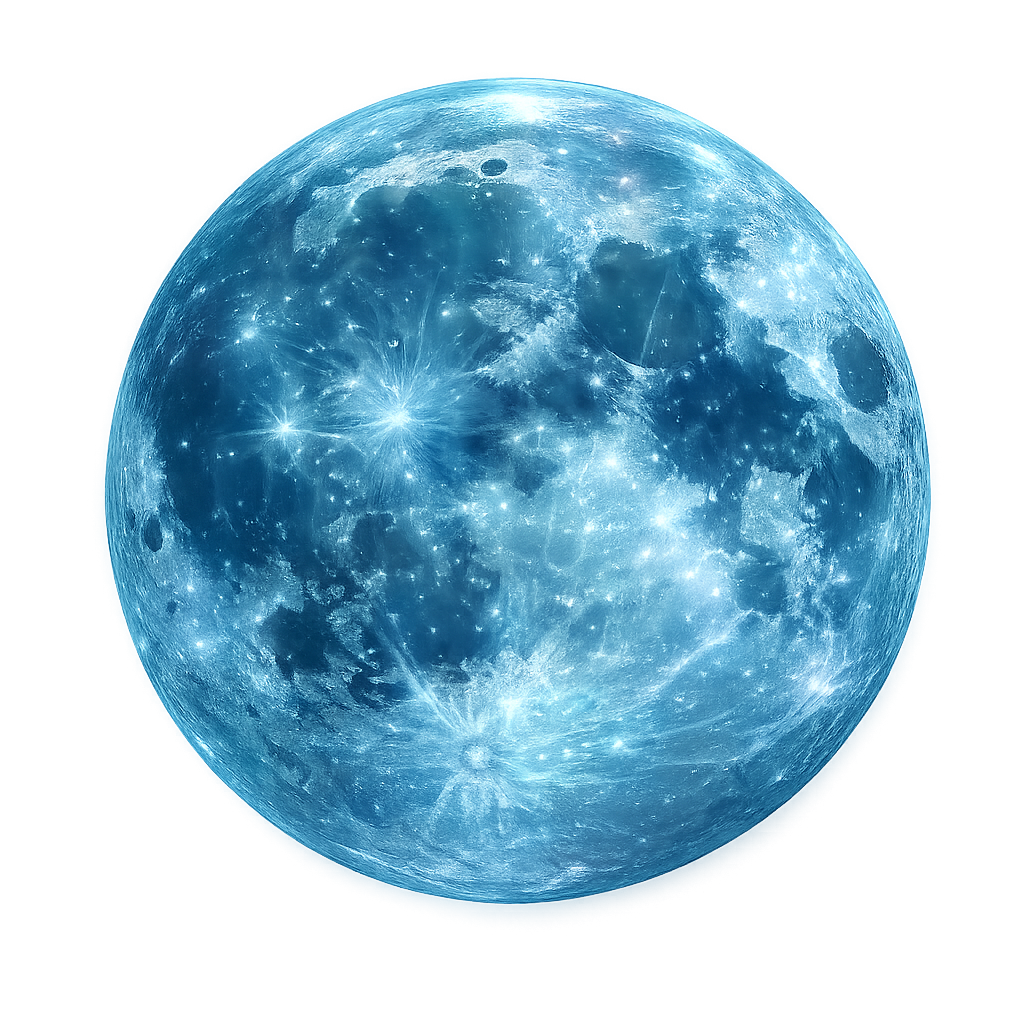
Why the Sky Runs Slightly Ahead of the Calendar
A Blue Moon is not caused by the moon changing color, brightness, or orbit. It is caused by timing.
A full lunar cycle lasts about 29.53 days — the time it takes the moon to travel from one full moon to the next as seen from Earth. Calendar months are 28, 30, or 31 days long. The mismatch between these two systems quietly accumulates, month after month, year after year, until something has to give.
Most months contain one full moon. But every few years, enough drift builds that a second full moon appears before the month ends. That second full moon is what most people today call a Blue Moon.
A solar year contains roughly 12.37 full moons. That fractional remainder — the 0.37 — is where Blue Moons are born. It gathers slowly, invisibly, until it tips the balance and an extra moon appears in the calendar where only one was expected. That is why Blue Moons arrive every two or three years, with the quiet inevitability of something that was always coming.
It also explains why February almost never experiences one. The month is simply too short to contain two full moons. In years when February holds none at all, the overflow spills into January and March instead, producing Blue Moons in both months during the same year — a rare doubling that feels almost too strange to be mathematical.
There are two accepted definitions. The modern version, now the most familiar, is simply the second full moon within a single calendar month. But older almanacs used a seasonal definition: the third full moon within a season that contained four instead of the usual three. That extra moon mattered because early calendars built their feast days, fasting periods, and planting schedules around expected lunar order. An unscheduled moon was a disruption to the entire system.
And occasionally, the moon really does turn blue.
After large volcanic eruptions or major wildfires, particles suspended high in the atmosphere scatter red wavelengths while allowing blue ones through. Under the right conditions the moon takes on a bluish or lavender cast — genuinely, visibly strange. This happened famously after Krakatoa erupted in 1883. For months afterward, observers around the world reported blue and green moons hanging in smoke-stained skies, the atmosphere itself made strange by what the earth had released into it.
Blue Moons can also overlap with other lunar conditions. One occurring near perigee — the moon's closest point to Earth — is called a Blue Supermoon, slightly larger and brighter than usual. One occurring near apogee becomes a Blue Wending Moon — the micromoon finally given a name worthy of what it actually looks like: something receding, unhurried, more elusive than its famous counterpart.
Because Blue Moons are defined by calendar timing rather than the moon's position in space, they can fall on slightly different local dates around the world. A full moon reaching peak illumination near midnight UTC may land in one calendar day in North America and another in Asia or Australia. Some regions experience a Blue Moon while others, watching the same moon overhead, technically do not.
The sky does not consult the calendar. It never has.
Humanity's Long Argument with the Moon
Blue Moons emerged from humanity's long effort to force the moon into orderly time.
The problem is not complicated, but it is stubborn. Lunar cycles simply do not fit inside a solar year. Twelve full moons fall slightly short of twelve months; thirteen full moons slightly overshoot. The moon drifts against every calendar ever devised, and every culture that ever depended on both the sun and the moon for timekeeping eventually had to confront what to do with the extra.
In medieval Europe, religious and agricultural life both depended on predictable lunar intervals. Feast days, fasting seasons, planting windows, and communal observances were organized around expected moonrise. When a fourth full moon appeared within a season, it pushed the others out of position — the names no longer matched the moments, the lenten moon arrived too early, and the rhythm that held the year together was quietly bent.
Across China, lunisolar calendars required sophisticated and continuous observation to prevent the seasons from sliding loose of their lunar moorings. Intercalary months were added periodically to keep them aligned — not treating the mismatch as a problem so much as a known feature of the sky, something to be managed rather than solved, an unavoidable part of keeping cosmic and seasonal order together.
Along the East African coast, Swahili communities navigated seasonal trade, sailing, and monsoon movement through close attention to lunar phases, tides, and ocean conditions. Moonlight shaped practical movement across sea and shoreline in ways that mechanical navigation would not replace for generations. The moon was not a symbol here so much as an instrument — reliable, continuous, necessary.
Blue Moons therefore emerged from a universal human problem: how to organize life beneath a sky that never moves in perfectly clean numerical patterns.
What We Made of the Unscheduled
Because Blue Moons arrive as extra moons rather than expected ones, they have long carried the emotional weight of the unscheduled. The phrase once in a blue moon became shorthand for rarity itself — for experiences that feel improbable, fleeting, or strangely charged with significance. Not impossible. Just unlikely enough to notice.
In Korean traditions surrounding Chuseok, the full moon is bound up with reunion, seasonal completion, and cyclical return. A moon arriving outside expected rhythm carries a subtle tension inside that — a reminder that even carefully ordered calendars remain vulnerable to drift, that continuity and disruption can arrive in the same light.
South of the equator, Blue Moons arrive in entirely different emotional climates depending on where they fall in the year. One rising over a southern spring landscape feels expansive, humid, alive with migration and insects and the electricity of growing things. The same event in southern autumn arrives differently — quieter, cooler, the nights lengthening around it. The same astronomical fact, dressed in completely different weather.
In Patagonia, where enormous skies and sparse land leave very little between a person and the horizon, an unusual moon feels isolated within the environment itself. A rare full moon rising above cold grassland, mountain silhouette, or open southern coastline does not compete with much. It simply occupies the sky. It feels less crowded by civilization and more embedded within the scale of the planet.
Rare moons gather memory easily.
Blue Moons often carry that quality regardless of where they appear: slightly outside ordinary timing, arriving one beat off from where the calendar said to expect them. Human beings notice when familiar cycles shift. Something in us registers the interruption before we have found the words for it.
A Mistake That Became the Definition
The most enduring story a Blue Moon ever tells is a private one. Weddings, reunions, departures, births, chance encounters that changed everything — these moments become emotionally tied to whichever moon happened to be overhead at the time. A Blue Moon overhead makes the coincidence feel almost intentional. As though the sky showed up for the occasion.
The strangest chapter in Blue Moon history belongs to Krakatoa. When the volcano erupted in 1883, ash spread through the upper atmosphere and altered the color of light around the globe for months. Observers reported moons appearing blue, lavender, copper, and green depending on where they stood and what the sky above them held. In some regions stars nearly vanished behind suspended particles while the moon glowed pale and cold in colors it had no right to be.
Similar reports have emerged from the smoke of major wildfires in Canada, Siberia, Australia, and the American west. Nights when the air itself was wrong, when the moon came up looking like something from a different atmosphere entirely. People who witnessed it rarely forgot it.
Then there is the story of how the modern definition was born — and it begins with a mistake. In March 1946, an amateur astronomer named James Hugh Pruett published an article in Sky & Telescope magazine. He was attempting to explain the seasonal Blue Moon definition used by the Maine Farmers' Almanac, but couldn't quite decode the almanac's tangled ecclesiastical calendar rules. So he made his best guess: a Blue Moon, he wrote, is simply the second full moon in a calendar month. Clean, logical, easy to picture. Also wrong.
The error sat quietly for decades. Then in January 1980, a radio host named Deborah Byrd used Pruett's definition on the NPR program Stardate, and it rippled outward into millions of living rooms. A year later, the designers of Trivial Pursuit came across the 1946 article and enshrined the definition as an official answer in the game. Overnight, a misreading became general knowledge — the kind of fact people confidently repeat at dinner tables without knowing where it came from.
By the time astronomers Donald Olson and Roger Sinnott tracked the error back to its source and published their findings in Sky & Telescope in 1999 — the very magazine that had started it all — Pruett's version had already won. The magazine acknowledged what it called its "Blue Moon blooper." But the blooper had become the definition, and the definition had become the one most people alive today know by heart.
A man alone with an almanac, making his best guess at something complicated. A radio broadcast carrying that guess across a continent. A board game pressing it permanently into the cultural record. And the moon overhead throughout all of it, indifferent to every definition ever written about it.
Blue Moons are uncommon enough to feel memorable, common enough that most people will encounter a handful across a lifetime. That is a particular kind of rarity — not once-in-a-generation, not legendary, but genuinely infrequent enough that when one arrives, it arrives with a little weight. A small event that feels, briefly, like it means something.
Maybe it does. Maybe that is enough.